Customer LOVE story · Twoday
Lauri Kurki leads Twoday's Salesforce business. Mikko Cavenius is an architect in its client projects. Both have been publishing every week since 2025, and each of them is read by a different half of the people who decide on a Salesforce project.
14.5x
Impressions, 2026 so far against 2024
9x
Comments, 2024 to 2026 so far
5.3x
Reactions, 2024 to 2026 so far

Lauri Kurki
Business Unit Director, Salesforce

Mikko Cavenius
Head of Data, AI & Architecture
Buying a Salesforce project is a decision made by two people who rarely read the same things. The commercial leader wants to know what the platform does for sales. The architect wants to know what it does to everything already running underneath. Convince one and you are halfway.
Twoday has been publishing with Haamu since May 2025, and the two people doing it cover both halves. Lauri runs the business and writes about leading sales. Mikko works as an architect in client projects and writes about what happens after the contract is signed. Together they reach about 79,000 people a month, and this story is about who those people are and why it took two voices to reach them.
Twoday is a Nordic technology company with around 3,000 specialists across the Nordics and Lithuania. Its Finnish Salesforce unit has worked on the platform since 2007 and sits alongside Twoday's data and AI teams, which is the combination its customers increasingly ask for.
Both started the way every Haamu customer starts: with a session on the business goals and a LinkedIn strategy built from those.
Two briefs came out of it. 👇
01
Lauri: the translator between sales theory and the sales floor
Lauri wanted to be the translator between what the research says about leading sales and what actually happens on a sales floor. He has an academic background in the subject, is writing a doctoral thesis on it alongside running the business unit, and wanted to put the two together in public.
“I want to talk specifically about what data-driven leadership is, what sales leadership is, what leading a service business is. What the theories say, what the academic world says, and then I translate it into plain language.”
02
What success would look like
He was equally clear about the result he was after: “For me, success would be customers getting in touch: come and talk to us about Salesforce, come and talk to us about Agentforce, come and talk to us about our data and what it means.”
03
Mikko: the other side of the same table
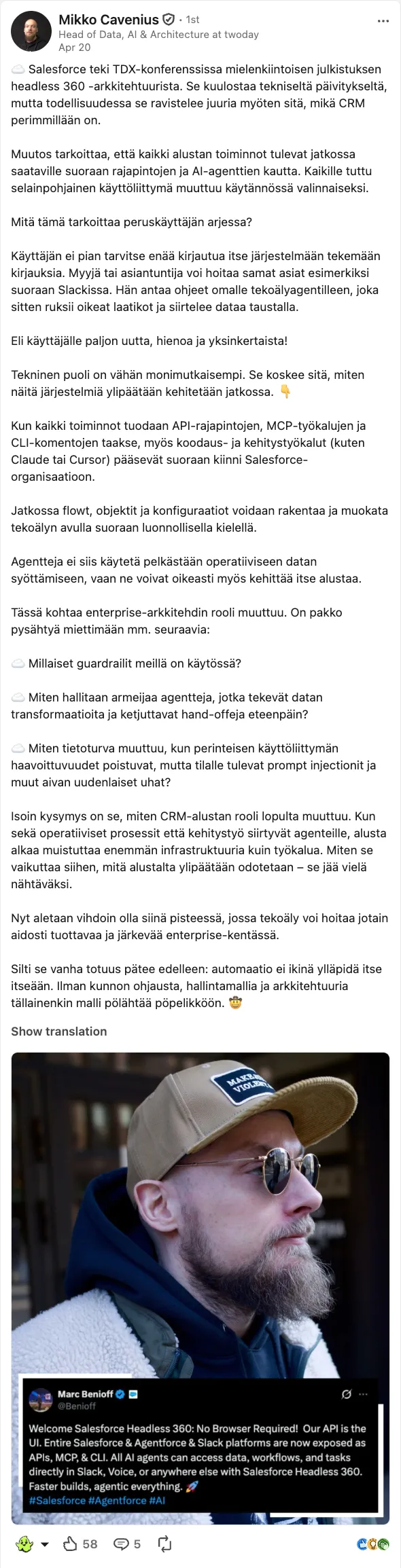
Where Lauri writes about winning the deal, Mikko writes about living with it: technical debt, what an architecture diagram does and does not tell you, why big platform deployments fail the first time, and what AI agents do to an enterprise estate. The brief was to say in public what an architect usually only gets to say once the contract is signed.
Lauri's audience
The commercial side of Finland's large industrial companies: heads of sales, commercial directors, and the people responsible for Salesforce and for data around them.
Mikko's audience
Architects, IT leadership, and the people who inherit whatever sales agreed to.
What neither of them wanted
Daily posting for its own sake, guru content, or anything that reads like a machine wrote it.
The rhythm
One recorded interview a month each, and a month of posts built from it. Both have kept to it since 2025. 🤝
Coverage
The clearest way to see the two audiences is to sort every post from the last six months by what it is about, and look at who wrote it. Same categories as in the Haamu platform.
Everything about hiring, talent and building a team is Lauri's, and close to three quarters of the leadership and management posts are his too. Two thirds of the opinion pieces are Mikko's, and so is most of the AI. Where they do share a category they are rarely writing about the same thing: Lauri's AI posts are about what it changes for a sales team, Mikko's about what it takes to make it work inside an enterprise estate.
The numbers
Both were on LinkedIn before Haamu, posting when they had time, which was almost never. The cleanest way to see the change is year against year: the calendar year before they started, the first year with Haamu, and this year so far.
Key figures
2024 vs. 2025 vs. 2026 to mid-October, both voices together
Posts published · 7x
2024
21
2025
104
2026 to date
148
Impressions · 14.5x
2024
54,000
2025
492,000
2026 to date
784,000
Reactions · 5.3x
2024
1,507
2025
6,668
2026 to date
7,960
Comments · 9x
2024
118
2025
979
2026 to date
1,067
79,000
People reached in an average month over the last six months. With more than two months of the year still to go, 2026 has passed 2025 on every line, and on impressions by 60%.
Voice one
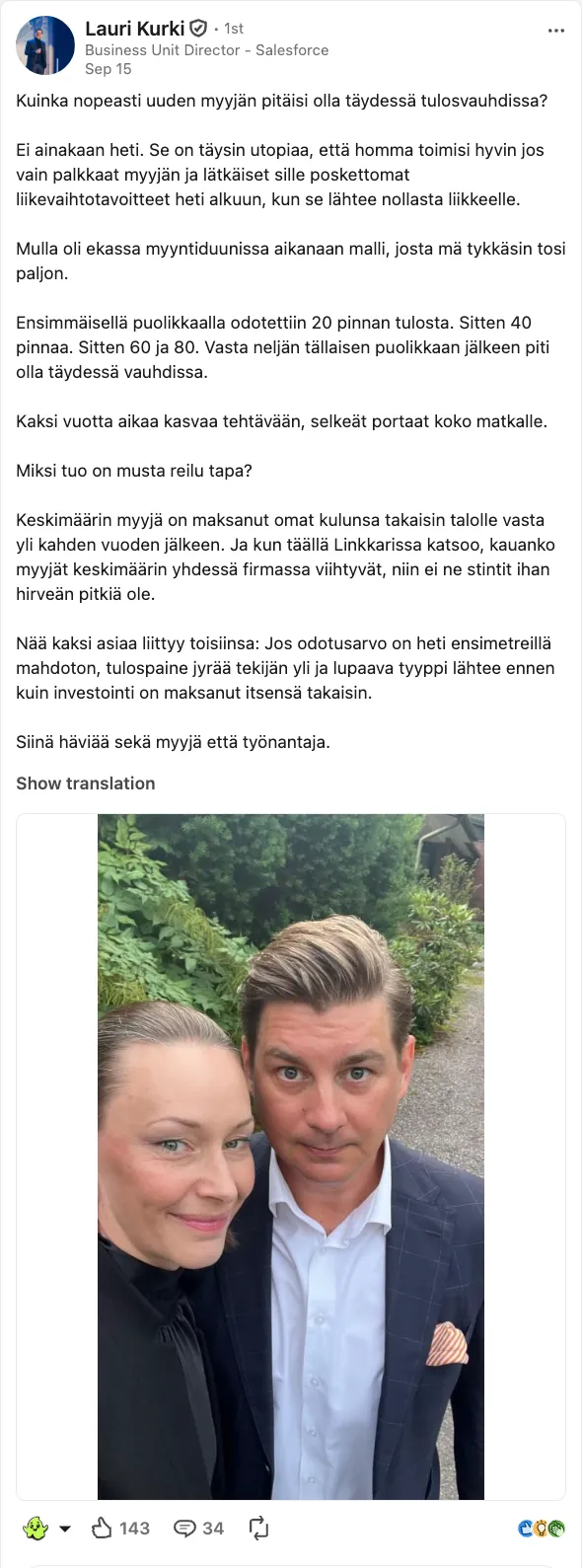
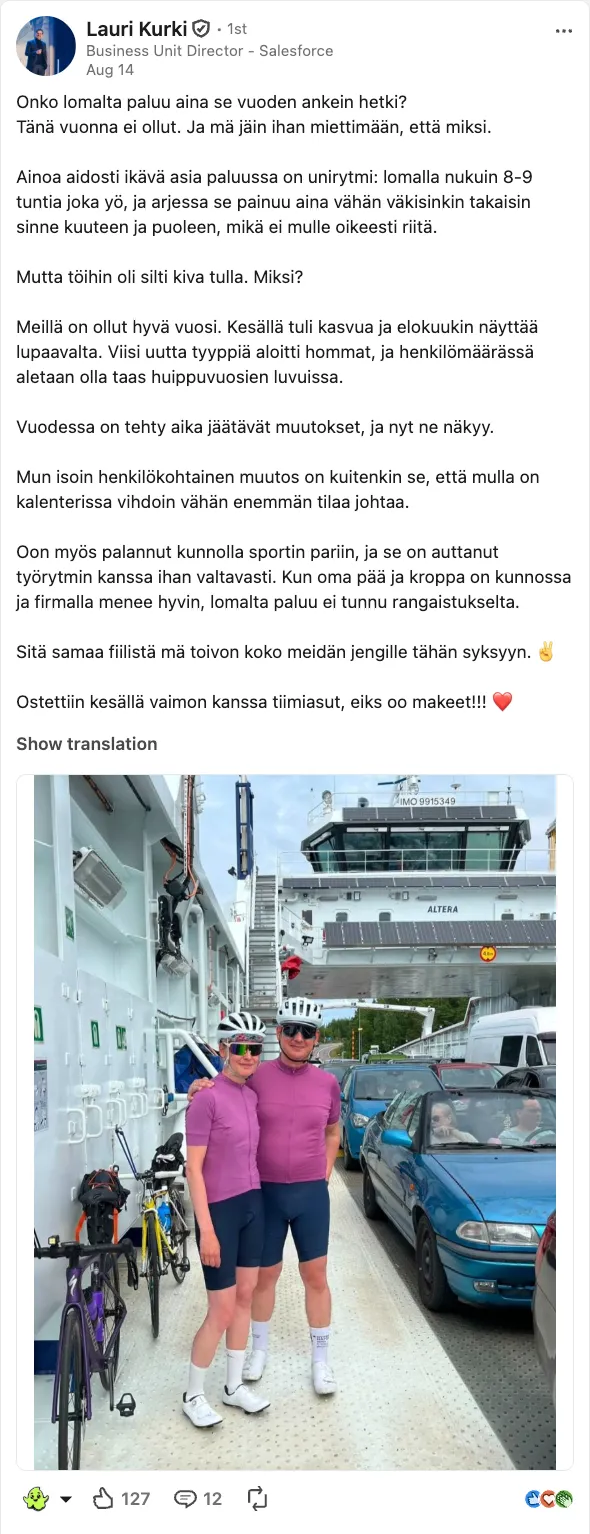
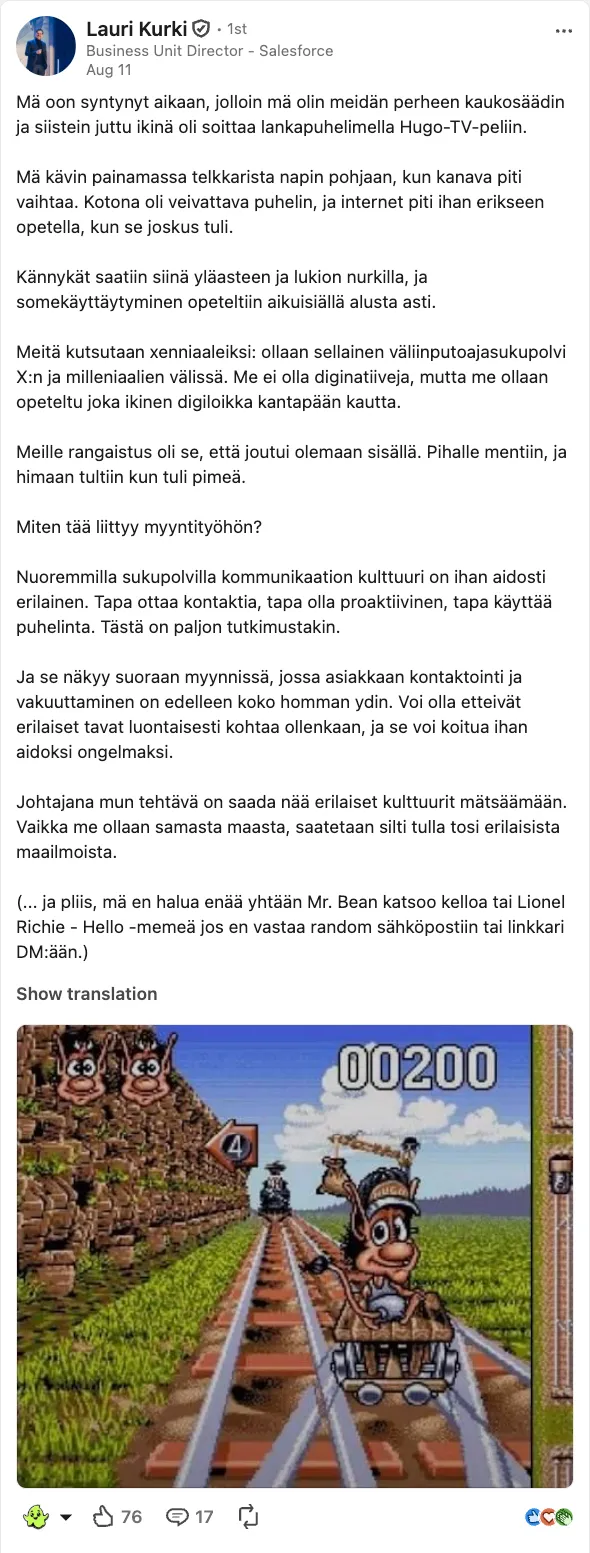
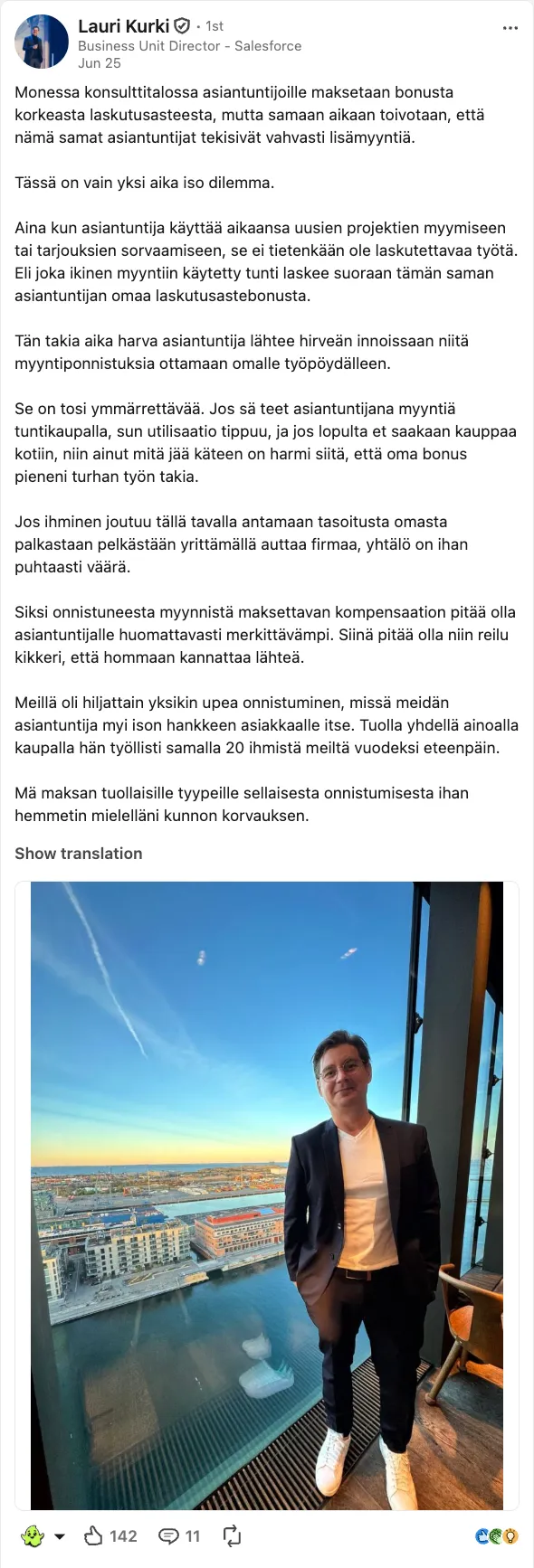
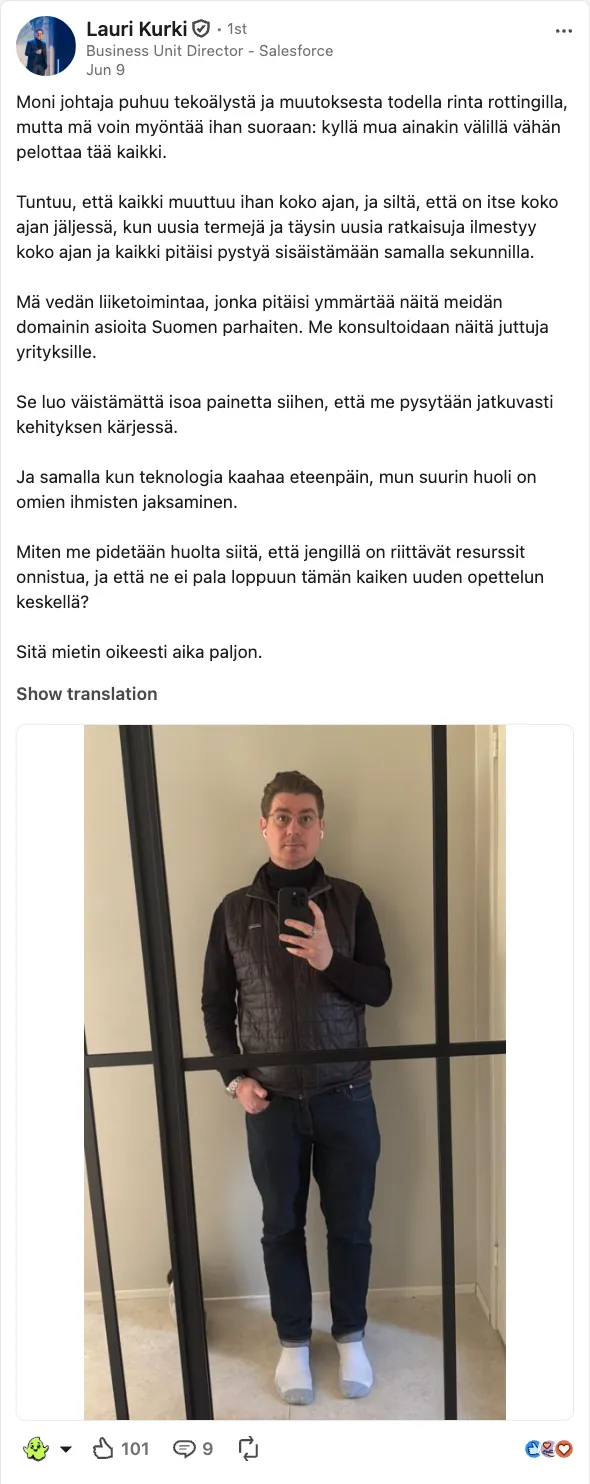
Lauri writes about sales leadership: How long a new salesperson takes to pay back the cost of hiring them, and why loading them with full targets in month one is a way to lose them. Why depending on one rainmaker is dangerous. What the 25-metric management model he grew up in got wrong.
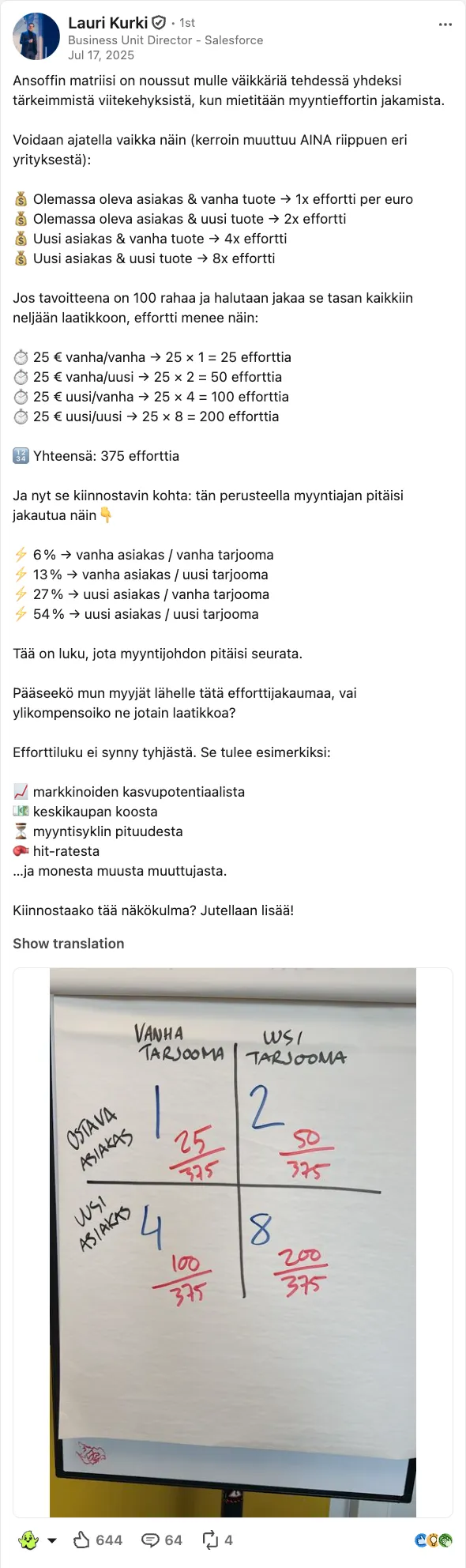
He also writes about the Salesforce ecosystem as a buyer sees it: what Agentforce does in a real deployment, why the company posts record quarters while its share price falls, and how he now runs his own sales from Slack rather than from the CRM screen.
Lauri has the larger following of the two, just over 4,000, and his posts reach around 39,000 people in an average month. The theme that has done the most steady work is the one he set out to own at the start: how you find a salesperson, bring them up to speed, and know when it is working.
A post on that theme reaches about 40% more people than his average post. It is also where the comments come from: sales leaders answering with their own ramp-up times, which is the audience the strategy named.
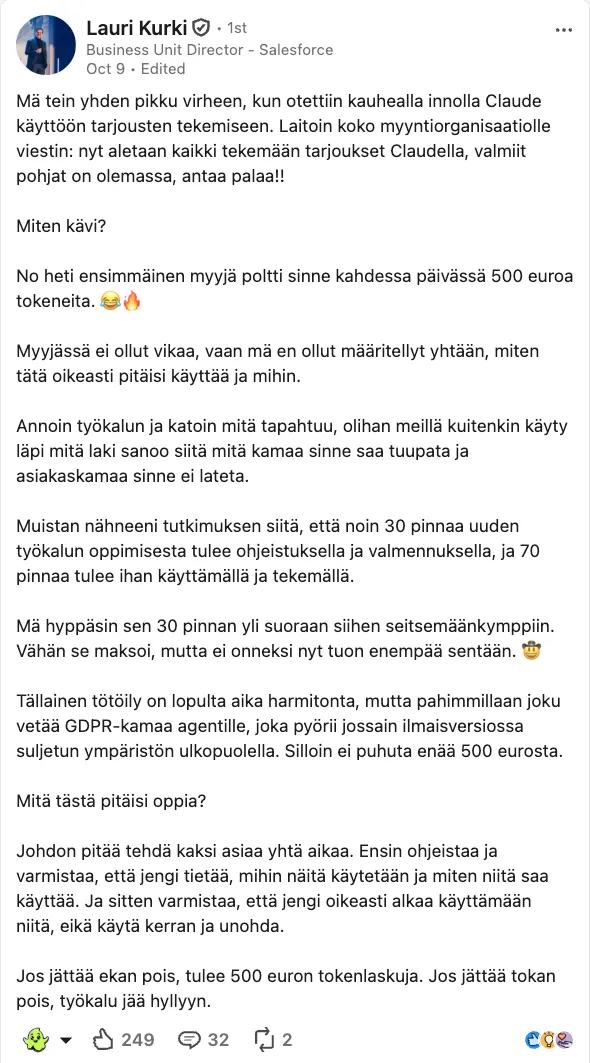
In October one post went past Lauri's usual reach.
He told the whole sales organization to start building proposals with Claude, templates ready, go.
The first salesperson burned 500 euros of tokens in two days!
The post is about what he got wrong as a leader, and what a leader has to do in two directions at once when a new tool arrives: set the rules, and then make sure people actually use it.
111,513
Impressions
80,021
People reached
247
Reactions
32
Comments
2
Reposts

Voice two
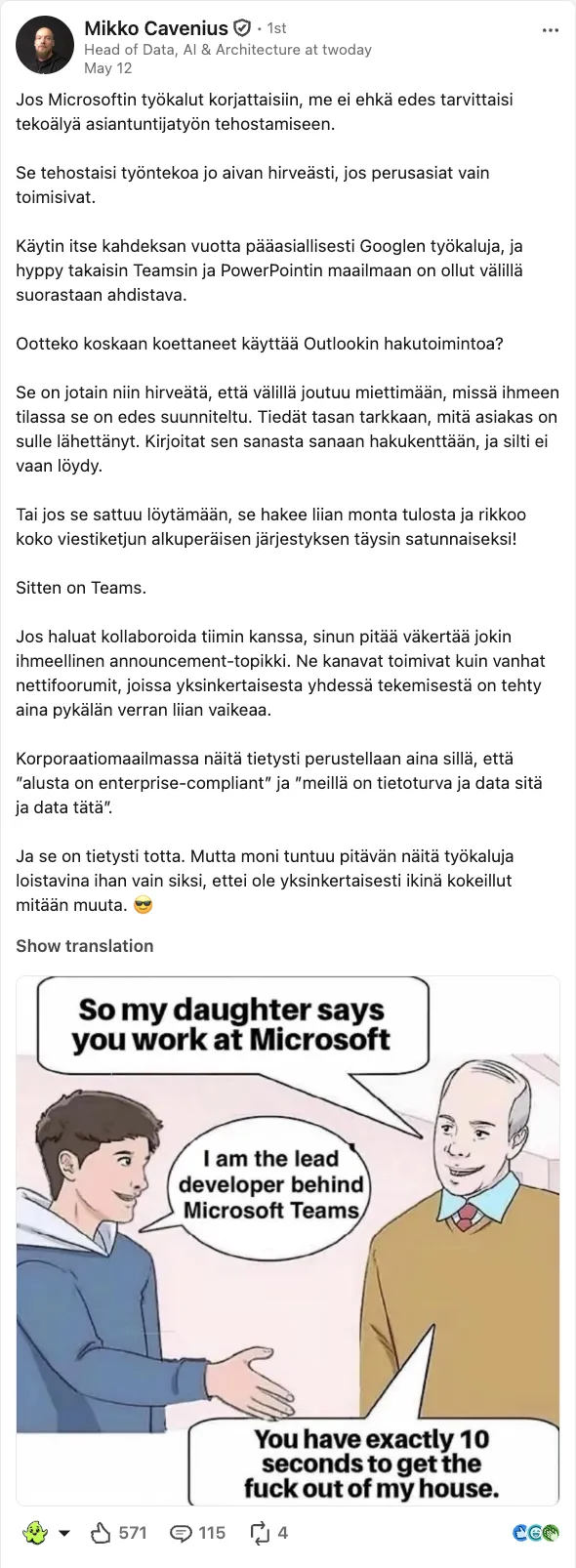
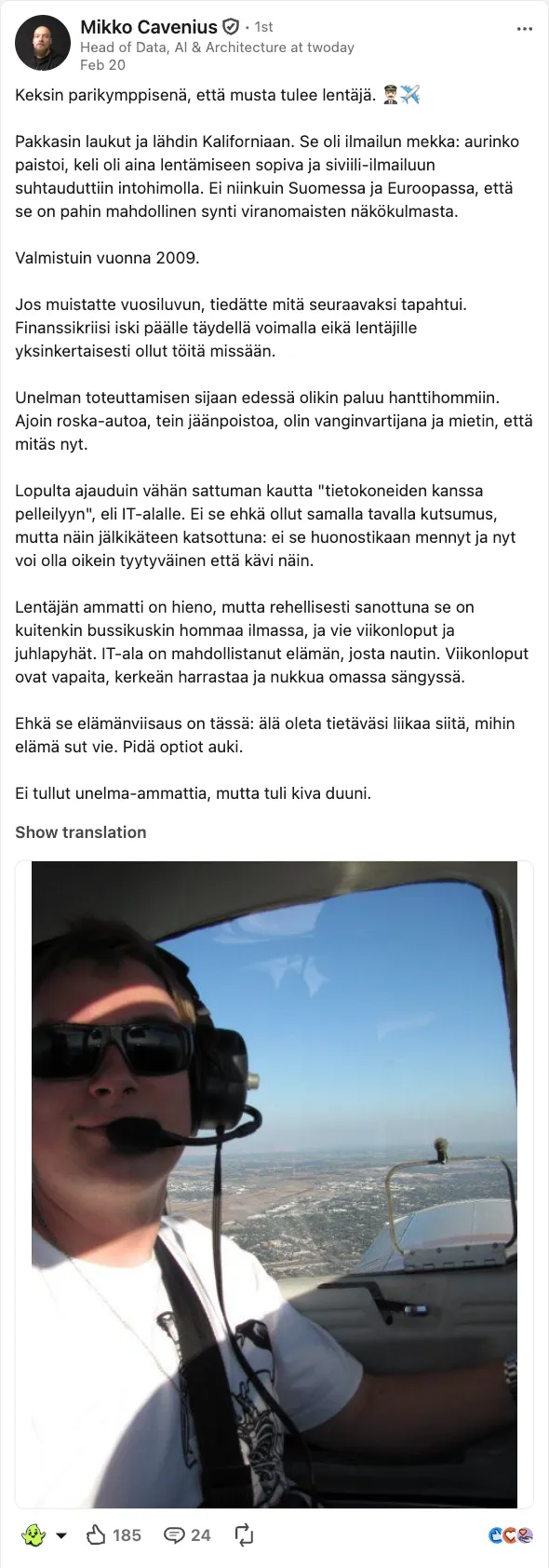
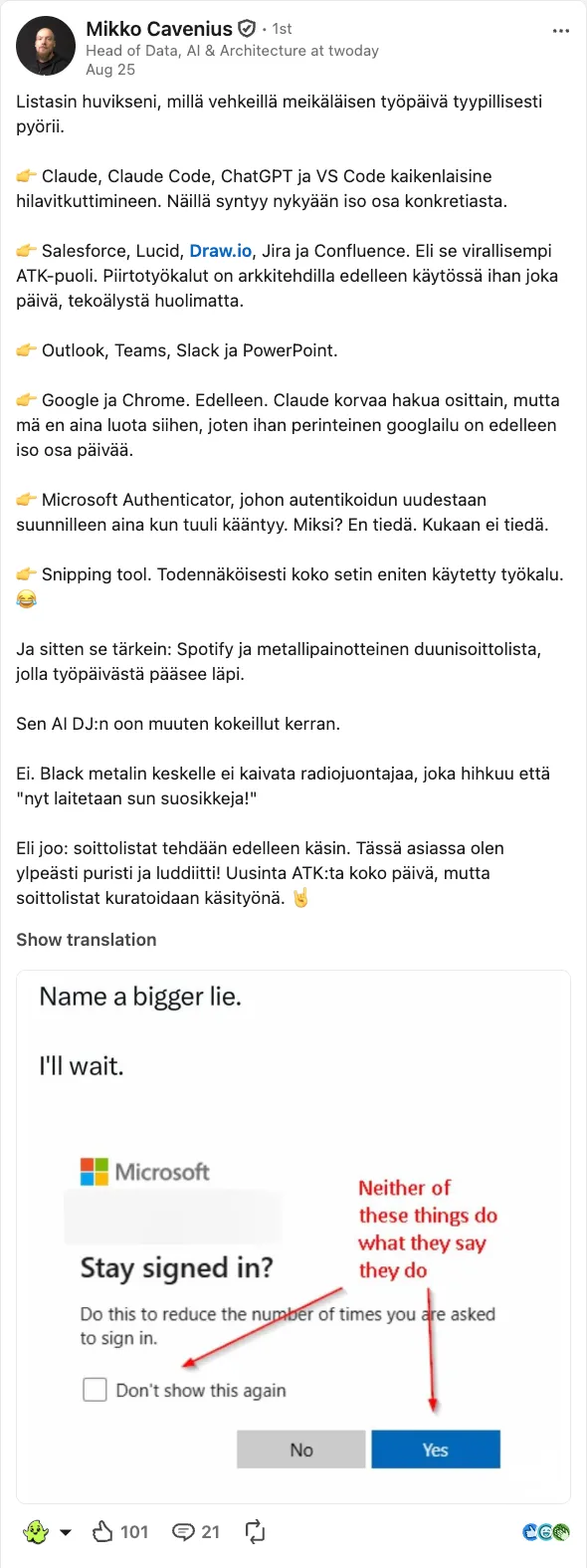
Mikko writes about the parts of enterprise technology that get decided in the sales meeting and paid for years later:
“Every session feels like therapy for the idea I'm trying to get out of my head, except at the end I have an actual piece of writing, not just a feeling of relief.
Haamu's process helps me structure my thoughts and shape them so that the audience actually understands what I'm trying to say.
I've always wanted to start writing something worthwhile on LinkedIn, but it takes time, and I've never had any.”
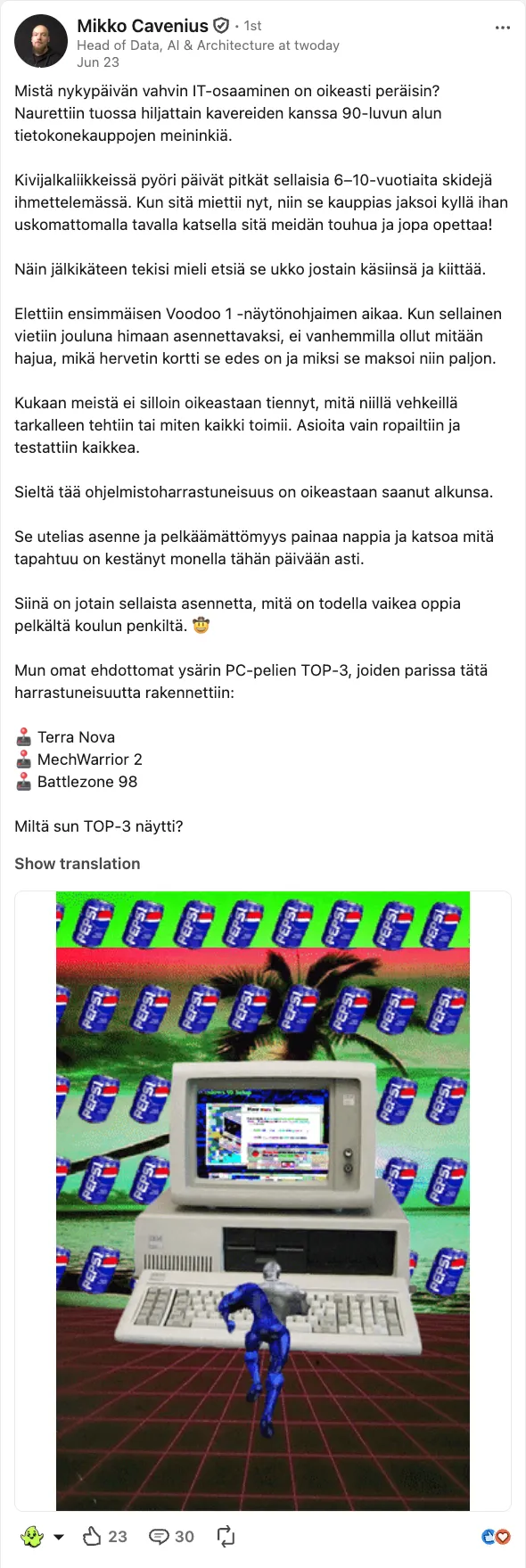
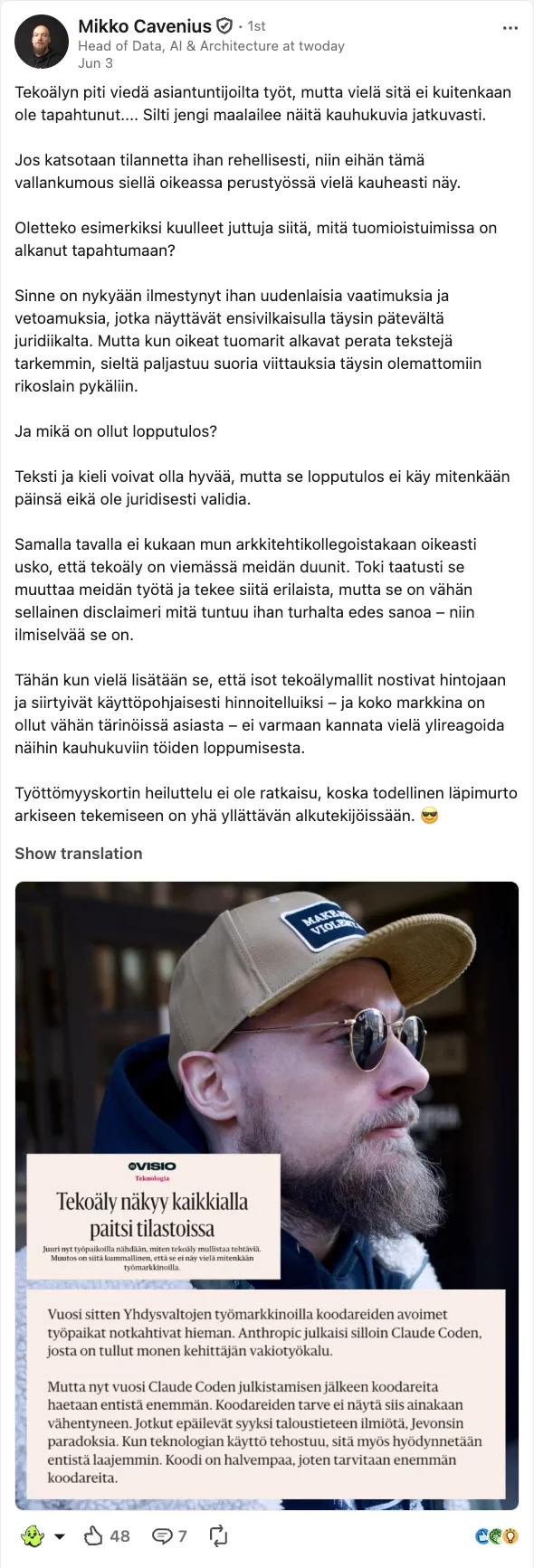
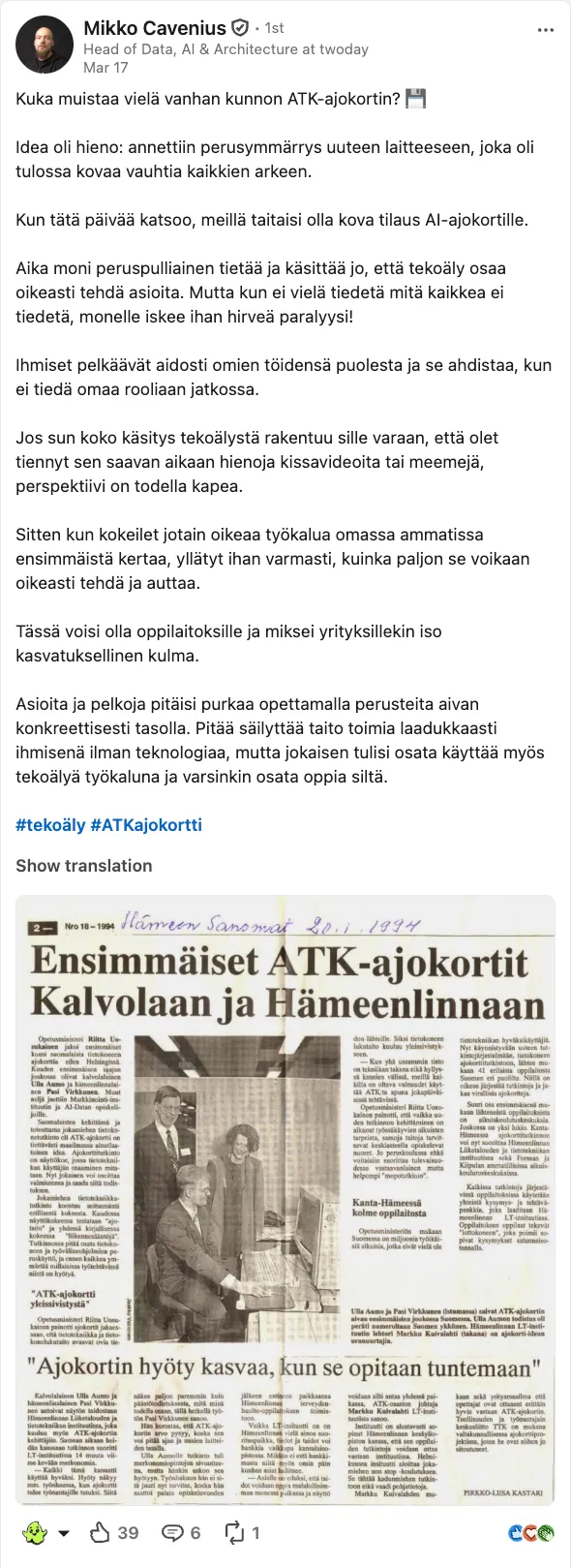
By mid-October Mikko had more than doubled his whole 2025 on impressions and was close to doubling it on comments. An architect writing about technical debt and agent governance does not usually get read outside his own field, and the comments are where you can see that he is: about ten per post over the last six months, and on the technical ones it is other architects doing the arguing, which is exactly the audience he was after.
Impressions
20x
2024
21k
2025
162k
2026 to date
428k
Reactions
5.8x
2024
715
2025
2,265
2026 to date
4,148
Comments
8.9x
2024
79
2025
384
2026 to date
703
Most read post in 2026 (this far!)
In August Mikko wrote about having led 150 people once, and what it taught him about the kind of leadership he never wants to do again: the half-hour weekly where five people sit through each other's status reports.
The post collected 825 reactions, more than any other post this year.
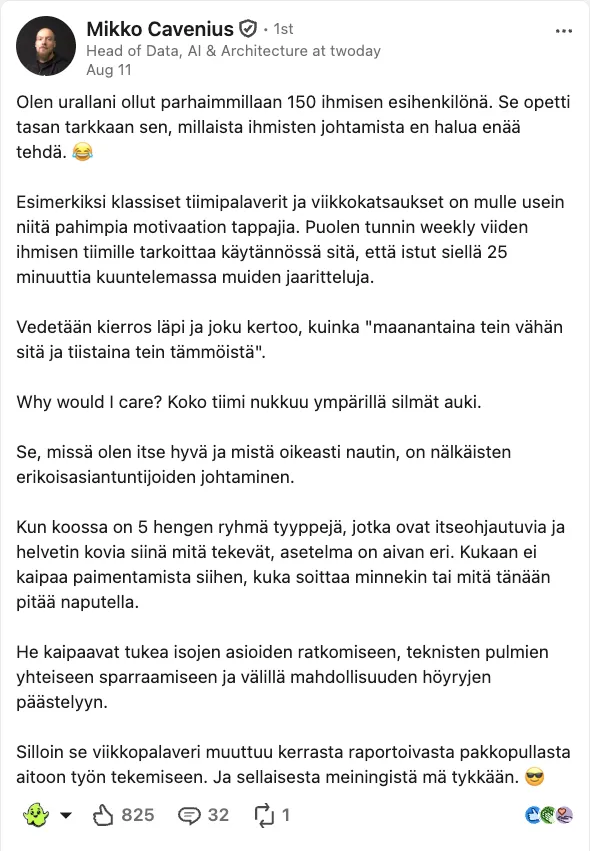
71,476
Impressions
50,513
People reached
825
Reactions
32
Comments
1
Reposts
The process
After the strategy session, both of them run on the same monthly rhythm.
Step 1
They talk
One recorded interview a month, each with their own ghostwriter, about what they are seeing at work, arguing with and learning.
Step 2
They review and approve
The interview comes back as a month of posts in their own voice, built from their own words and examples. Nothing is scheduled before they have approved it.
Step 3
The posts go out
Haamu publishes them on schedule. They answer their own comments.
Step 4
The numbers come back
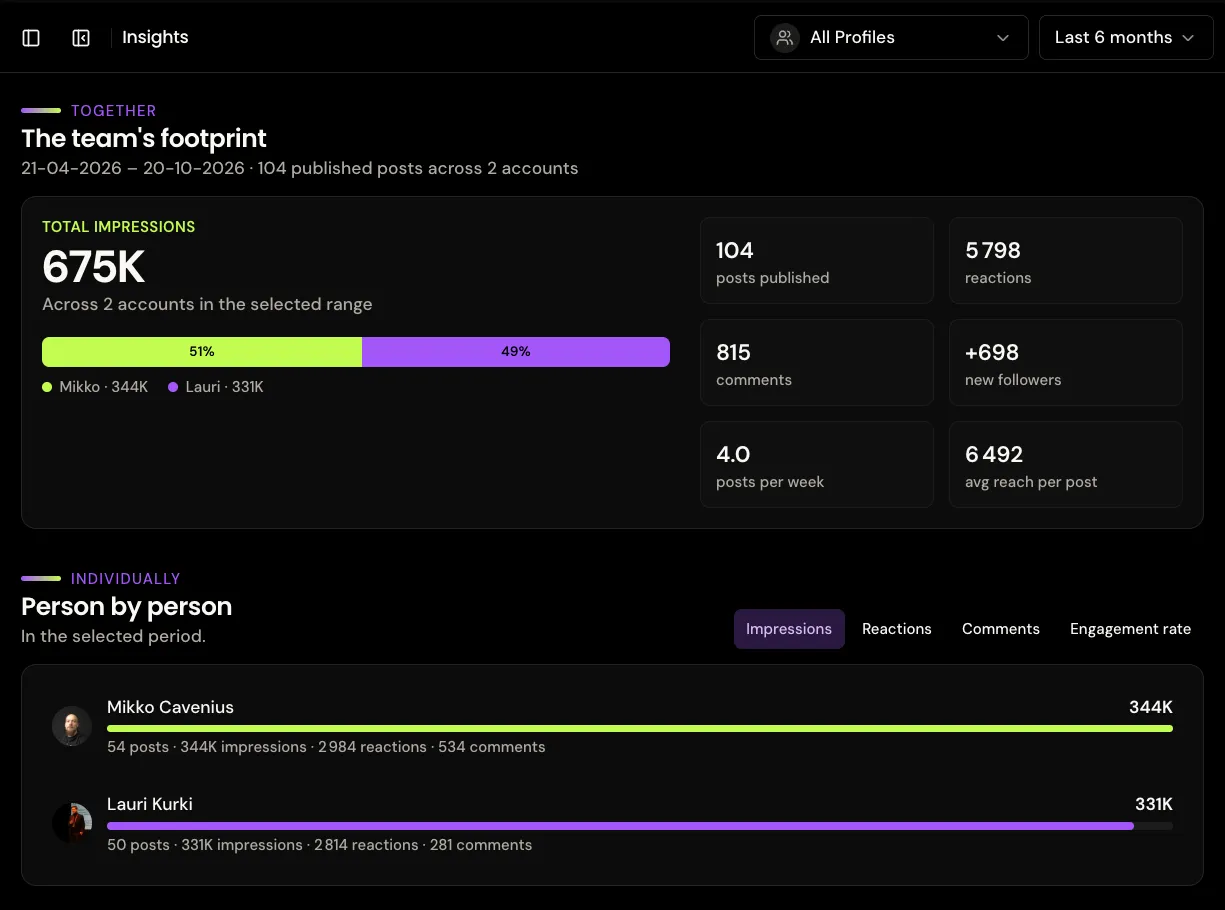
Every post's reach, reactions and comments land in the Haamu platform, for each of them individually and for Twoday as a whole. Before the next interview, three things get checked: the strategy, what the data says about the last month's posts, and what is timely in their field right now, from research and news to the discussions running on Reddit.
For the company
LinkedIn shows each person their own numbers and nothing else. The Haamu platform collects analytics at both levels, each profile on its own and the two of them added together.
If your product is bought by more than one kind of person, one voice will only ever reach one of them.
Ready to build your own LinkedIn growth story? Let’s have a chat!
Solo plan

HSL
A public organization speaking through a person instead of an institution, on one hour of his time a month.
19.8k → 618k
impressions, a year vs 8 months
Solo plan

Ville Tolvanen
A board professional whose decades of experience are finally visible, so people walk into meetings already knowing his thinking.
205k → 1.06M
impressions, in five months
Team plan


Byro Legal
A law firm building a LinkedIn voice in a famously cautious industry, and becoming the one clients already recognize.
206k → 1.94M
impressions, in a year
Team plan


Growberries
A startup that turned an occasional LinkedIn presence into content that actually stops the scroll.
49k → 325k
impressions, a year vs 5 months
Team plan




Tracklution
A SaaS company where the CEO, sales, partnerships and growth each post in their own voice.
4.2M
impressions across four voices
Solo plan

Huoneistokeskus
A CEO with plenty to say about the housing market and no time to write it down, now the one her own agents read.
6.3x
reactions in six months