A CEO doesn't have to weigh in on every hot topic of the day. Being completely bland isn't a great idea either, though, if you want to build thought leadership.

Content by
A CEO doesn't have to weigh in on every hot topic of the day. Being completely bland isn't a great idea either, though, if you want to build thought leadership.
Harvard Business Review just published a column by Nitin Nohria, former dean of Harvard Business School, that asks whether people want CEOs to stay quiet.
Stanford researchers surveyed 2,807 Americans in September, asking whether the CEOs of large companies should speak out on social and political issues.
55% of respondents said yes. Back in 2018, the figure was 65%.
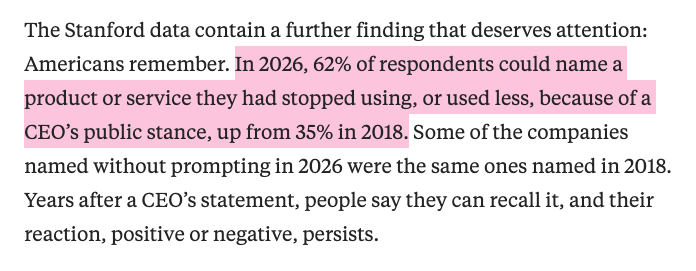
62% of respondents could also name a product or service they had used less because of a CEO's public stance. In 2018, that share was 35%. That's quite a jump!
Plenty of people won't buy a Tesla because of Elon Musk. A Finnish example is the textile brand Finlayson: many people say they boycott it because of the public stances of Jukka Kurttila, its business director. At the same time, plenty of people love Jukka and buy Finlayson products precisely because of those stances.
Lots of big feelings around business leaders!
According to Nohria, the public still accepts, and is more comfortable with, leaders speaking about things directly tied to the company's own work.
Apple's Tim Cook was able to defend encryption against the FBI because nobody wondered why Apple had a view on it: privacy was what Apple sold.
At Haamu, we think about the same thing every time we build a LinkedIn strategy for a new client. In the kickoff, we start with the easy question: what do you want to talk about? Leaders can usually answer that fairly quickly, because it's essentially the same question as which themes matter most for executing the company's strategy.
We also ask whether there are topics they want to rule out entirely.
The answers are strikingly similar. Especially here in Europe, a CEO's first reaction is almost always the same: anything else is fine, I just don't want to take a strong stand on politics.
Unless, of course…
Once you dig a little deeper, the line starts to move. What actually counts as politics? In a way, everything is political. Plenty of social issues are highly political, and so are many questions about running a company.
Heard in our kickoffs
Anything but politics. Unless…
I want to talk about social issues, but not politics. I can talk about pensions for entrepreneurs, though, I have a lot to say about that.
I don't want to talk about politics, but I could take a stand on labor legislation.
Let's leave politics out, except that I'd still like to encourage people to become entrepreneurs.
I can talk about anything, but I don't want to comment on the situation in Palestine.
The pension example is a juicy one. How people fund their pensions is a hot topic whenever entrepreneurship comes up. It's a highly political question, yet because it's tied to entrepreneurship, people don't see it as a political statement in the same way.
Some don't want to say a single word about it, others have very strong opinions.
So why are we so cautious?
I believe part of the reason is that in Europe, we're simply not used to the same loud, outspoken style that is common in the US. We easily think we shouldn't say too much about a topic we may not know enough about. We fear criticism so much that we'd rather stay quiet than get labeled.
On the other hand, many worry that the discussion will take attention away from the actual day job.
The article asks when a company and its CEO have an OBLIGATION to speak out on social issues. The idea feels a bit American to me, but it stuck with me anyway.
I don't know whether a leader is ever truly obliged to take a stand on anything, but if the discussion is very closely tied to your own business, it gets pretty close to an obligation.
Examples like these are fairly clear-cut.
The harder ones are topics where the audience expects everyone to take a stand. Some companies, for example, decide not to take any stance on Pride Month. Then there's always someone asking: "Oh, so you don't support human rights for everyone?!"
That kind of conversation easily spirals on social media.
The audience may feel everyone has an obligation to speak up on these issues, even if the company doesn't see the matter as equally important and would just like to "focus on doing our job." At the same time, silence is often a statement in itself, whether you like it or not.
There are no right or wrong answers here. Everyone has to find a way of speaking that suits them.
We, like anyone else, don't have a universal, ready-made test or form for this. If something is in the news and we happen to have an interview with a client, we might ask: hey, any thoughts on this? The leader then decides how taking a stand feels. If it feels really uncomfortable, we skip the question. If it turns out that "actually, yes, I do have something to say about this," we dig into it and turn it into a post. Even after that, the leader can still decide whether to publish it.
Pretty rarely do those go unpublished. They almost always go out, and everyone usually finds their own way of handling things in their own style.
Many get braver little by little, as posts pile up and they notice that nothing bad happened, even though they shared their own thoughts.
Sometimes the opposite path is chosen deliberately: this social phenomenon is one we'll take a stand on all the time. If a company sells, say, office space solutions, that phenomenon could be remote work. Then we look for every possible study, news story, article and discussion, and take a stand on all of them. Sometimes even provocatively!
A leader is completely free to limit the conversation to their own work topics if they don't want to weigh in on the hot topics of the day. You don't necessarily lose anything by doing so, though the result may end up a bit pale.
People generally like it when someone shows opinions and something of themselves. That makes them more relatable, and the connection people form with them is deeper and stronger than if everything stayed a bit vague.
Nobody needs to be fiery or polarizing. That doesn't necessarily even fit the European mindset very well. Being completely bland usually isn't good either.
So go ahead, be brave: share your thoughts with the world!
Even when you know not everyone will like them. 😎
Written by
Co-Founder & CEO