Impressions are down across LinkedIn, and it is not just your imagination. What changed, what our data says, and what still works? You'll find some answers to these questions in this post. :)

Content by
Impressions are down across LinkedIn, and it is not just your imagination. It has happened to everyone, and in this article, we go through some of the reasons, and also some things that still work.
If you have looked at your LinkedIn analytics lately and thought "this used to be better," you are not imagining it. And you are not doing worse work, either!
Reach is down across the platform. It's down for people who post daily, and people who post weekly, and just as well for accounts with 500 followers and accounts with 50,000.
It is down for us too. And we do this for a living! 🖖
So we collected everything we know about the recent algorithm changes, put it next to what our own data actually says, and wrote it all down in one place.
For the data part we went through all 2,771 posts our managed accounts published between March and September 2026.
Let's dig in! (Or if you are in a hurry, jump straight to the TL;DR at the end. 🏃♀️)
Same caveat as always (if you read our monthly What works on LinkedIn data, you know the drill), because it changes how you read everything below.
The accounts in our data are normal professional profiles, not full-time creators or even less full-time LinkedIn influencers. They are founders, executives and subject-matter experts posting alongside a day job.
The typical account sits between 1,000 and 5,000 followers.
If that sounds like you, this is your peer group!
Eight things that happened to the feed, and what our own numbers say about them.
Worth getting out of the way, because it explains a lot of the noise.
LinkedIn counts an impression when at least 50% of your post is visible on a signed-in member's screen for at least 300 milliseconds (LinkedIn Help: post analytics).
Half a post on screen for 0.3 seconds is one impression
300 mson a signed-in member's screen
Impressions 1
Nobody has to read it, react to it, or even notice it. Scroll past twice and it counts twice.
That is it. Nobody has to read it, react to it, or even register that it happened. Repeat views count too, so one person scrolling past your post twice is two impressions.
Which means your impression count moves for all sorts of reasons that have nothing whatsoever to do with whether the post was any good.
On 12 March 2026, LinkedIn's engineering team published a piece called Engineering the next generation of LinkedIn's Feed. Worth a read, but here is the compressed version.
They threw out the old approach, where the feed was assembled from several separate retrieval sources, and replaced it with two things.
👻 A single LLM-based dual encoder for retrieval. You and every piece of content get turned into semantic embeddings, and the system matches by meaning rather than by keyword or connection. It runs a nearest-neighbor search against a GPU-accelerated index and comes back with candidates in under 50 milliseconds.
👻 A transformer-based Generative Recommender for ranking. Instead of scoring each post on its own, it reads your engagement history as an ordered sequence and ranks from there.
This means the feed no longer starts from "who does this person follow" and filters down; it starts from "what is this person interested in" and works outward.
Your connection list went from being the foundation to being one input among many.
From "who follows you" to "who cares about this"
Your network
Matched by topic
⚠️ You will see confident posts claiming LinkedIn's feed is now run by something called 360Brew, a roughly 150-billion-parameter foundation model.
The paper is real: LinkedIn's Foundation AI Technologies team published it in January 2025.
⚠️ What does NOT exist is any LinkedIn statement confirming that 360Brew ranks your feed, or any announcement that it has been rolled out.
So: real research, real direction of travel, but "360Brew is why your reach dropped" is a claim that has been repeated a lot rather than confirmed once.
The March 2026 engineering post is the part that is actually documented.
We mention this because clients read those posts and ask us about them, and it is nicer to be the person who knows which half is verified. ☝️
You can verify this one yourself in about thirty seconds.
Open any recent post, click through to analytics, and look at the discovery breakdown. LinkedIn now shows you how impressions split between people in your network and people outside it.
On three of my own recent posts, 74% to 88% of impressions came from OUTSIDE my network.
This cuts both ways, and the second half is the part people miss:
– Your followers are no longer a reliable floor. Having 5,000 connections does not guarantee that 5,000 people see anything.
– Your followers are no longer a ceiling either. A post on a niche topic can land in front of thousands of people who have never heard of you.
⚠️ And there is both good and bad in this. Obviously it is good that a post can travel far even from a small network. But it would also be quite nice if the people who actively chose to follow me were still seeing my content?! The current ratio seems a tad unhealthy to me. Interesting to see how it develops.
In September, LinkedIn started testing a separate Network tab: a feed with only the people you are connected to or follow. In the words of LinkedIn's Chief Product Officer Hari Srinivasan: "We all want more real connection with real people, and we hope this plays a small part in rebuilding that world." It is only a test for now, and earlier network-only feed tests never made it to everyone. But I am keeping my fingers crossed. 🤞
If your reach has become more volatile, this is why. Distribution is now decided per post, on topic, instead of being handed to you by your follower count.
This is the part of the story where people quote statistics that do not survive checking.
There is a widely repeated figure of "two million posts a day on LinkedIn" that traces back through a chain of marketing blogs citing each other, with nothing at the end of the chain. We are not going to use it as a fact, although it is probably a fair ballpark.
What is on the record, from Microsoft's own earnings calls: LinkedIn had close to 1.3 billion members as of October 2025, and has now reported double-digit member growth for five consecutive years. Satya Nadella cited double-digit engagement growth over the same period, alongside a heavy push into short-form video.
And in May, LinkedIn VP Laura Lorenzetti put a number on the posting side: content creation on the platform is up 14% year over year. (She also credited AI for part of that growth. More on that in a second. 👀)
So the member base keeps growing at double digits, LinkedIn keeps adding formats to fill, and the number of posts any one human will scroll through in a day has not changed at all.
You do not need a precise number to see where that lands. More people posting into a fixed amount of attention means a thinner slice each.
This part is not an algorithm decision. Just… math.
More content has also meant more slop: posts that look polished and say nothing. LinkedIn has been unusually loud about it this year.
In May, it announced that generic AI content would no longer be recommended to people outside the author's own network. Over the summer, it dropped its own AI rewrite feature and replaced it with a proofreader that keeps your voice. And then came the "Seems like AI slop" button, right there in the feed.
According to Srinivasan, over a million people used it in the first two weeks, and content LinkedIn classifies as slop is now getting 40% fewer views than it did a few weeks earlier. If your post collects enough of these reports, you also get a private note about it in your analytics. (How many is enough, LinkedIn hasn't said.)
My first thought about the whole button was YES! But the worry kicked in almost immediately after. Reporting tools on social media bend into pitchforks pretty easily, and I am not entirely sure it is a good idea to hand this kind of moderation power to users in the first place. Especially since I am quite sure "AI slop" does not even mean the same thing to everyone.
Plenty of people label a text slop just because it has an em dash in it, or some other mannerism that smells of AI. But bad writing or bad editing does not make a post slop. Bad, clearly AI-generated content with no thought or insight of its own does.
Bland mush gets made without machines too!
To be fair, LinkedIn draws the line in roughly the same place. It describes slop as content that is "polished in its presentation, but lacks substance," and says reports mostly shape the reporter's own feed, with safeguards against pile-ons.
For what it is worth: two weeks into the button's life, I had not come across a single post where I would even have considered pressing it. Says quite a lot about my feed. Carefully curated, every follow chosen with devotion. 🙏
The largest independent dataset on this comes from Richard van der Blom, covering 1.3 million posts from around 50,000 creators. The headline: reach is down roughly 60% for active creators over the last two years.
More usefully, the shape of it, from his data and a couple of other big datasets:
– Engagement fell too, but far less: down 20% to 25%.
– Company pages have taken the worst of it, with organic reach down 60% to 66% between 2024 and early 2026.
– Video views on company pages fell 36% year over year, across every page size.
What is left of a 2024 post
Take a 2024 post as 100. This is what the same post gets today.
That first line is the interesting one. Fewer people are seeing each post, but a higher share of the ones who do are actually engaging.
Which is precisely what LinkedIn said it was optimizing for.
Key takeaway: Comparing today's post to a post from eighteen months ago is comparing two different products.
We track every post our managed accounts publish on the Haamu platform, which means we get to check this against something more reliable than a feeling. For this piece we went through all 2,771 posts published between March and September 2026, starting from the month LinkedIn rebuilt its feed.
What we found is a clear dip, but not a free fall.
The same accounts are now reaching about a quarter fewer people per post than they did in March and April. That is nowhere near the 60% in van der Blom's data, but it is clearly there.
The consistency is the part that should reassure you. This is not happening to some accounts and not others: by September, roughly four in five accounts were below their own spring level.
If it were only some, that would point at something those particular accounts were doing wrong. Instead the floor moved for nearly everyone, at roughly the same time… which is exactly what you would expect after a platform rebuilds the way its feed picks what to show.
It also did not keep sliding. Most of the drop happened between April and May, right after the rebuild. The summer brought a small rebound, and September came back down to roughly where May was.
The same accounts reach about a quarter fewer people
People reached per post, compared with the same account's own March–April. The typical account, month by month.
people reached by the typical post, spring vs. September
accounts were below their own spring level in September
We read that as a reset to a lower baseline rather than an ongoing collapse.
Every post our managed accounts published between March and September 2026. All figures are medians: the typical post.
Everything in this half comes from the Haamu platform, looking at every post our managed accounts published between March and September 2026.
One note on how we are reporting it. Instead of quoting averages, which a couple of runaway posts can drag anywhere, we use the median: the typical post, the one right in the middle. The numbers below are how many people that typical post reached.
Sorted by whether the post carried an image, a video, or nothing at all:
Image posts reach twice as many people as text-only posts
People reached by the typical post
Image posts reach twice as many people as text-only posts. That is the largest single gap in the whole dataset, and it holds every month. It also holds inside individual accounts: for three in four of them, their own image posts beat their own text posts.
Video, notably, does not beat images. It lands somewhere in between.
An image stops the scroll before the reader has decided whether to read. A wall of text has to earn that pause on its own.
And the specific thing we keep having to say to clients: the image that works best is usually a selfie, a screenshot, a photo from the actual meeting or the actual site. Not the studio headshot from the corporate photoshoot.
The professional photo signals "this is marketing." The slightly imperfect one signals "this is a person."
One of those gets read. :)
👉 Why the slightly failed selfie wins, and why our brains simply cannot stop looking at faces, is a whole story of its own. I wrote about it in In a world of AI imagery, people crave double chins and nose hairs.
Posts under 600 characters reach the fewest people, but the gap is a lot smaller than the internet would have you believe. And when we compare posts from the same account against each other, the short ones hold their own just fine.
The algorithm is not counting your characters. A long post often happens to be a post with an actual insight in it, but a short one can carry one too: a sharp thought, a quick update with a twist, or a meme – which is also an awesome content type and we love it!! It just rarely should be the ONLY thing you do. ;)
All in all, the feed treats them the way readers do.
What to do with it: Let the point decide the length. When you have a real argument, give it room and make it properly. When you have a quick thought, keep it quick.
The typical post with an external link in the body reached 756 people. The typical post without one reached 1,250. That is about 40% fewer.
LinkedIn would rather keep people in the feed than send them somewhere else, and it prices that accordingly.
What to do with it: This is a trade, not a rule. If the post genuinely needs the link, put it in the post and accept that it will reach fewer people. If it does not need one, leave it out.
This is the finding that outranks all the formatting advice combined, and the one that comes back in our monthly data every single month.
Accounts posting three to five times a week build roughly three times the monthly reach of accounts posting one to three times a week. And their per-post performance holds up rather than thinning out, so posting more often costs nothing per post.
It works inside individual accounts too. In the months when an account stepped up to three to five posts a week, its monthly reach grew by about 70% compared with its own quieter months.
Three to five posts a week, three times the monthly reach
People reached in a typical month, by posts per week
Reach per post: 1,042 at 1 to 3 a week1,529 at 3 to 5 a week
Every other item on this list adjusts a single post by some percentage. This one multiplies the whole month.
What to do with it: The floor matters more than the ceiling. Three posts a week, held consistently, beats one brilliant post a month by an enormous margin.
Packaging gets a post seen. These four decide whether it is worth carrying to strangers.
Everything above is about packaging. Put an image on it, give it enough room, skip the link, show up often enough……
All of it works! But none of it tells you yet what to actually write. 🤠
And that is the part that decides whether a post travels, because the algorithm now reads for meaning rather than for keywords. It is looking for content worth carrying to strangers. So the question stopped being "how do I format this" and became "is there anything in here."
This half is not a percentage table. It is what we watch happen across the roster every week.
Start in 1960s America.
Avis built an entire marketing strategy on an uncomfortable fact: they were number two in car rentals, and everybody knew it.
"We're #2. We try harder." "Avis can't afford not to be nice." "Avis can't afford half-empty gas tanks."
They admitted their position out loud, in every single ad. It worked so well they kept the line for 50 years.
The same mechanism runs the best content on LinkedIn today.
Look at what actually performs here. Income reveals. Founders opening up about the quarter that went wrong. Agencies publishing their real pricing. Consultants writing about the project that failed.
Honesty performs because it is scarce. When the feed is full of polished wins and humble brags, the moment someone says "you know what, I got this badly wrong"... people stop scrolling.
And it does a second job at the same time. Honesty filters.
When you are upfront about what you are and what you are not, the wrong-fit audience selects itself out, and the right-fit audience already trusts you before the first call. Avis did not want the customer who only wanted the biggest brand. Saying so out loud saved everyone's time.
To be clear, this does not mean confessing everything or manufacturing drama for reach. If it is not genuine, people will smell it.
What to do with it: Find the true thing others in your industry are too nervous to say, and say it calmly.
The pattern we see most consistently across the whole roster, and the one that has become more pronounced as the feed has filled up with generic content, is that posts carrying something only that person could have written travel furthest.
Not necessarily confessional. Specific.
A decision and why it was hard: a number from your own business, something you believed two years ago and no longer do, or a moment from an actual week at work.
At the other end sit the category posts: general observations about leadership, marketing or AI that could have appeared under anyone's name.
Content about AI has taken the hardest hit of all, and not because nobody cares about AI. It is because most of those posts say the same thing in the same register.
Here is the test we use internally: Take your post, delete your name from the top, and ask whether anyone reading it could guess who wrote it.
Name hidden. Could you guess who wrote it?
Two example posts
Great leaders invest in their people. When your team grows, your business grows. What is your take?
Anyone. Literally anyone.
Last Tuesday I told our biggest client we would miss the deadline. I called two weeks early, with a new plan. They signed for another year.
Only the person who made that call.
If a competitor could have published the same text without changing a word, the algorithm has no reason to prefer your version of it… and neither does the reader. 🤷🏻♀️
What to do with it: You do not have to share your salary or your worst year. What you need is a post where the reader learns something true about you.
Everything above argues for substance: honesty, specificity, and an actual point. And then someone posts a meme with six words on it and it outperforms the thoughtful piece you spent an hour writing! Hahaa!
Worth understanding why, because the reason is not (only!) that "people just like jokes."
Memes work as badges of belonging. Social identity theory, which Tajfel and Turner put a name to back in 1979, says we build a sense of who we are out of the groups we belong to. A meme is the fastest membership test ever invented. Getting it puts you inside the group. Not getting it puts you outside (poor boomer).
So a meme is not really a joke, but a recognition test.
The reader is not laughing at the content so much as recognizing their own working life in it, and the quickest way to say "this is my world" is to send it to somebody else who lives there.
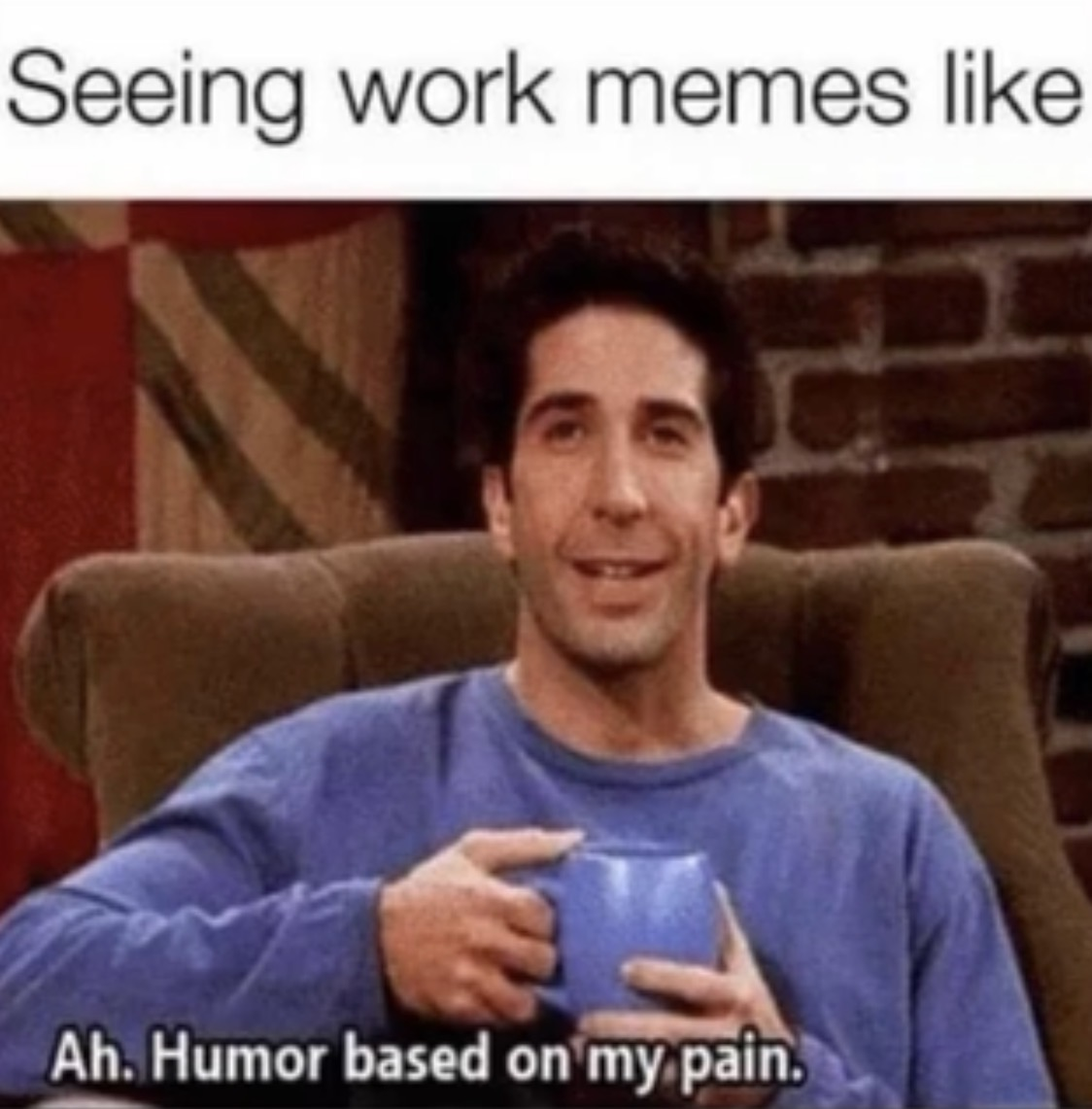
This is also why generic humor does very little in B2B, while a joke that only people in one specific corner of one specific industry could possibly understand does a lot. The narrower the in-joke, the stronger the signal.
Feeling seen is the whole product.
It is the same mechanism behind any bit of collective joy online: that shared, contagious feeling of a community coming together, and the sense that WE are experiencing something together rather than just feeling something at the same time as individuals.
⚠️ The catch is that a meme buys recognition, not authority. Nobody has ever hired anyone off a meme. It opens the door, and something with substance behind it has to walk through.
What to do with it: Post them, enjoy them, we love them!! Just do not let them be the only thing you do. ;)
The most common way a good post dies is not bad writing. It is polishing.
Now that many leaders and CEOs are writing more on social media (as they SHOULD 🤌), the old content committee has found a new target: personal profiles. Well-meaning people polish the leader's posts until nothing even slightly questionable remains.
And what happens when you sand off every interesting edge?
You don't get a diamond; you get a ball.
Polish a diamond long enough and you get a ball
A diamond.Sharp edges catch the light. People stop, look, and sometimes argue.
Getting safer.One more round of comments from the committee…
A ball.Smooth, safe, nothing to disagree with. Nobody notices it.
For a company page that is merely boring. For a personal profile it is fatal: the posts stop sounding like the person, the person stops recognizing themselves in them, and posting starts to feel like wearing someone else's suit.
What a way to kill the motivation!
But committees are the easy version of this problem, because at least you can see them coming.
The harder version is when the person does it to themselves.
"Is this too obvious?" "Is this bragging?" "Does posting this make me look stupid?"
We hear those questions constantly, and the people asking them are most often the ones with the least reason to ask. Genuine experts, sitting on something worth saying, quietly talking themselves out of saying it. (In Finland, maybe even more than elsewhere: I wrote about that in Finnish humility is killing our brands.) The draft goes through one more check… and then one more, until the thing that made it worth reading has been checked out of it.
And I am not observing any of this from a pedestal. I have sat on a finished post for two days because "the data isn't exact enough". I currently have 74 drafts waiting, because in my mind they are not good enough yet.
There is no magic fix for it. But one embarrassingly simple thing works: hearing "this is good, post it" from someone you trust. Half of our job is being that person for our clients.
Because the edges are the whole point. That is what people follow, remember, and sometimes argue with. A post nobody could disagree with is a post nobody notices, and in a feed this crowded, going unnoticed is the only real failure.
What to do with it: Polish the writing. Keep the edgesssss. 😎
There are a lot of numbers in this article, and it is tempting to go and audit your last twelve posts against every single one of them.
Please do not do that to yourself.
The accounts growing fastest in our data are not the ones optimizing hardest. They are the ones showing up two or three times a week with something specific to say, in a voice that sounds like a person rather than a press release, for long enough that it compounds.
Your job is having things worth saying. We will handle the rest. 👻
Written by
Co-Founder & CEO