Finnish companies have world-class expertise but struggle to make it visible. In a world flooded with AI content, attention and trust are won by those who dare to step forward.

Content by
Finnishness lives in Fazer Blue, the Moomintroll, the sauna, and Tervaleijona. Sometimes, and often I’m told, also in mämmi – at least around this time of year. It lives in that quiet nod with which we greet our neighbor in the stairwell, and in that deeply rooted fear that we might accidentally be too visible or in someone’s way.
It would almost be a miracle if this didn’t show in Finnish brand strategies as well. And of course it does.
In our marketing materials, there is often a kind of deep, national self-effacement that is best captured by a phrase familiar from coffee tables: “Don’t bother brewing coffee just for me.”
Finnish companies have an enormous amount of brilliant minds and world-class innovations, but we keep our views and expertise tightly under wraps, because we are afraid of being seen as pushy.
The result is that, in international markets, a Finnish company is often a bit scentless and tasteless, and at best long drink grey. We are that polite guest sitting quietly in the corner of the coffee table, hoping that someone would notice our excellence without us having to open our mouths.
This is a dangerous strategy in a situation where the rest of the world is shouting into a megaphone.
Let’s take a recent example from the place we traditionally always look to (because that too is part of Finnishness), namely Sweden.
The Swedish company Lovable has done something that makes a Finnish engineer gasp. At Lovable, they didn’t retreat into chambers to wait for customers to discover the product, but instead our Swedish friends made a huge deal out of themselves from the very beginning.
They claimed the narrative, took up space, and created a phenomenon that left competitors wondering what just happened. And the growth has been enormous. At the same time, here we look at such unfiltered self-confidence with discomfort and grumble that the product isn’t that amazing anyway.
The fear of embarrassment and losing face runs deep in us. Risks are avoided until the very end, and it shows in a harsh way in how we communicate. It is marked by the illusion that humility and invisible hard work will at some point bring an automatic reward.
But now, on the global stage, for many companies we are at a point where that illusion is becoming unbearably expensive. Invisibility is the worst possible risk management strategy.
In 2026, the competition is not won by the one who manages to build the best product or piece of code, but by the one who captures the buyer’s attention – and through that, trust. When anyone can, with the help of AI, produce massive amounts of material at the push of a button, we have started to crave authenticity and human connection as a counterbalance. That is why a logo or a brand mascot alone is no longer enough – alongside it, faces are needed.
At Lovable, those faces are CEO Anton Osika, who shares updates about building the company on social media every day (what a show-off?!). The company also has other visible leaders, such as growth lead Elena Verna and CRO Ryan Meadows, who each tell Lovable’s story from their own perspectives.
People follow people. When a leader steps forward and speaks about things directly to the audience with their own name and face, the whole company transforms from a distant, generic organization into a human actor. A leader’s personal visibility and expertise across social media, podcasts, opinion pieces, and appearances build credibility in a way that no paid advertising campaign alone can.
There are many other good examples globally. Google’s CEO Sundar Pichai reaches a multiple of the audience compared to official company accounts with his posts, Chili Piper’s founder Alina Vandenberghe has been building the company’s reputation with her own face for a decade, and HubSpot’s CTO Dharmesh Shah is practically legendary in his social media game.
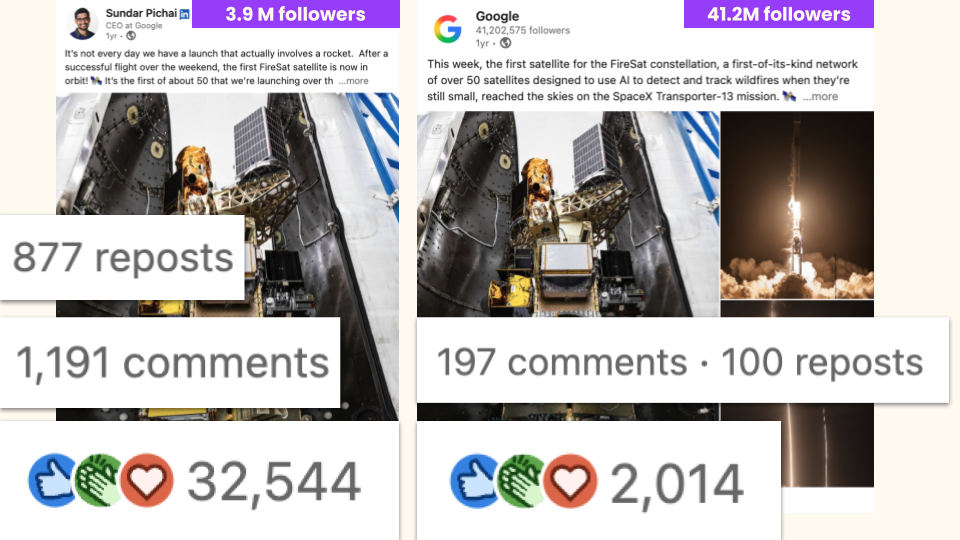
In Finland, company leadership is still, for now, a sadly underutilized asset in marketing. Humility is not a bad trait, but when taken too far, it turns into toxic invisibility that no board should allow. If you are not actively telling your own story, someone else will tell it for you – and not necessarily in the way you would want.
Elsewhere in the world, people might not know what mämmi is, but they already know that “my voice will probably carry just fine without a microphone” is not much of a brand strategy. Maybe it’s time for us, too, to stop sitting there in silence and make something of our expertise? Perhaps Lovable’s Anton and Elena could next be Finnish Akseli and Elina.
So next time someone asks you if you’ll have coffee… just say yes. ☕️☕️☕️
Written by
Co-Founder & CEO